
Suggestions
Guide for authors
Searcher
Journal Information
Vol. 61. Issue 12.
Pages 725-808 (December 2025)
Cite
Cite
Share
Download PDF
More article options
Vol. 61. Issue 12.
Pages 725-808 (December 2025)
Original Article

Early Failure, Late Failure, and Sustained Response to Biologics in Severe Asthma: A Long-term, Real-world, Multicentre study

Visits
4471
D. Dacal Rivasa,b, E. Martinez-Moragónc, V. Plazad,e, C. Cisneros Serranof, C. Benchimold,e, H. Izaguirre Floresg, S. Sánchez-Cuéllarh, M.D. Martínez-Pitarchi, C. Fernández Aracilj, A. Trisán Alonsok, J.C. Serrano Rebollol, Z. Vásquez Gambasicam, R.M. Díaz Camposn, P. Trujillo Mulatoo, I. Escribano Gimenop, D. Laordenq, E. Arismendir,s, N. Marina Malandat, A. De Diego Damiau, M. Ferrer Galvanv..., I. Dávilaw,x, J. Ortiz de Saracho Boboy, B.G. Cosioz, L.A. Pérez de Llanoaa,b,
Corresponding author
eremos26@hotmail.com

Corresponding author.
,
REMOTE study group Ver más
a Pneumology Service, Lucus Augusti University Hospital, EOXI Lugo, Monforte, Cervo, Lugo, Spain
b University of Santiago de Compostela, Spain
c Pneumology Service, Doctor Peset University Hospital, Valencia, Spain
d Servicio de Neumología y Alergia, Hospital de la Santa Creu i Sant Pau, Barcelona, Spain
e Universidad Autónoma Barcelona, Facultad de Medicina, Barcelona, Spain
f Pneumology Service, La Princesa University Hospital, Instituto de investigación La Princesa, Madrid, Spain
g Servicio de Neumología, Complejo Hospitalario Universitario de Canarias, Las Palmas, Spain
h Servicio de Neumologia, Hospital Universitario Ramón y Cajal, Madrid, Spain
i Hospital Lluís Alcanys de Xátiva, Valencia, Spain
j Servicio de Neumología, Hospital General Universitario Dr. Balmis, Universidad Miguel Hernández, Instituto de Investigación Sanitaria y Biomédica de Alicante (ISABIAL), Alicante, Spain
k Pneumology Service, Hospital Universitario Puerta de Hierro Majadahonda (Madrid), Spain
l Hospital de Llerena-Zafra, Spain
m Hospital Universitario de Getafe, Madrid, Spain
n Servicio de Neumología, Hospital Universitario 12 de Octubre, Madrid, Spain
o Instituto Nacional del Tórax, Santiago de Chile, Spain
p Hospital Infanta Sofía, San Sebastián de los Reyes, Madrid, Spain
q Department of Pulmonology, La Paz University Hospital, Madrid, Spain
r Servei de Pneumologia del Hospital Clínic de Barcelona, IDIBAPS, Universitat de Barcelona, Barcelona, Spain
s CIBERES, Instituto de Salud Carlos III, Spain
t Departamento de Neumología, Unidad de Asma Grave, Hospital Universitario Cruces, Bilbao, Spain
u Area de Enfermedades Respiratorias, Hospital Universitario y Politécnico La Fe, Valencia, Spain
v Pneumology Service, Hospital Universitario Virgen del Rocío, Sevilla, Spain
w Servicio de Alergia, Hospital Universitario de Salamanca, Spain
x Departamento de Ciencias Biomédicas y del Diagnóstico, Facultad de Medicina, Universidad de Salamanca, Salamanca, Spain
y Pneumology Service, Hospital Universitario del Bierzo, Ponferrada, Spain
z Department of Respiratory Medicine, Hospital Universitario Son Espases-IdISBa-CIBERES, Palma de Mallorca, Spain
aa Pneumology Service, Lucus Augusti University Hospital, EOXI Lugo, Monforte, Cervo, Lugo, Spain
Ver más
Podcast
This item has received
Article information
Abstract
Full Text
Bibliography
Download PDF
Statistics
Abstract
Objectives

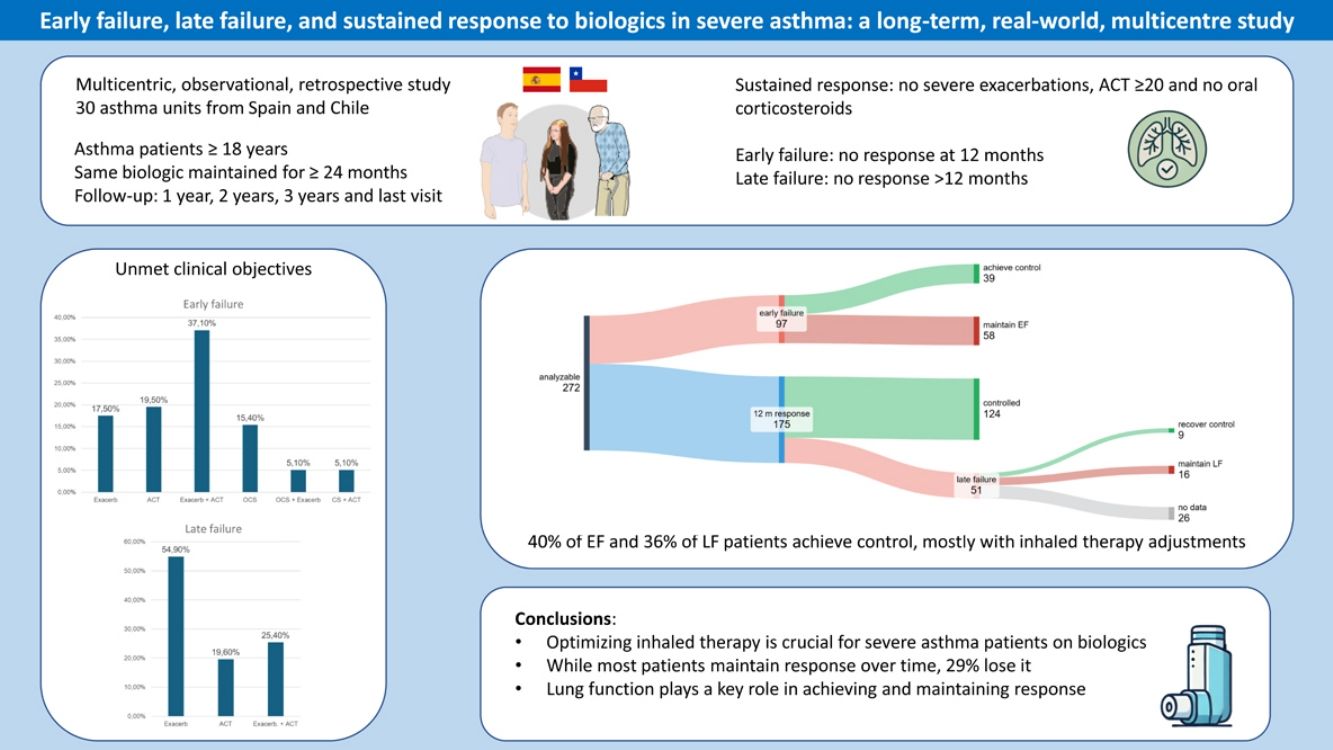
Only one-third of patients with severe asthma (SA) achieve a complete response to biologics. This study aims to characterize two types of failure: early (EF), occurring ≤12 months after biologic initiation, and late (LF), occurring at any time during follow-up after response has been achieved at 12 months.

Methods

This is a multicentre retrospective study of adults treated with the same biologic for ≥24 months. Response was defined as no severe exacerbations in the preceding 12 months, asthma control test ≥20, and no need for maintenance oral corticosteroids. Failure (EF or LF) was defined as non-achievement of any of these objectives.

Results

Two hundred and seventy-two patients were analysed with a mean follow-up of 46.1±19.4 months. At 12 months, 97/272 were classified as PF, but 40% of them recovered response on subsequent visits (by changing inhaled therapy in 74%). Among the 175 responders at 12 months, 124 (70.8%) maintained response throughout the study period, while 51 (29.1%) experienced SF; those patients had lower FEV1 values after 12 months of biological therapy. SF reverted in 36% of cases, with inhaled therapy changes in 41.6%. FEV1 decreased by ≥100mL in 12 of 16 cases who did not recover response after SF.

Conclusion

Most patients who achieve response at 12 months maintain it over time, but 29% of them suffer LF. Optimization of inhaled therapy can aid response recovery from EF or LF. Maximizing pulmonary function helps to prevent loss of response.

Keywords:
Severe asthma
Biologics
Early failure
Late failure
Long-term study
Treatment response
Graphical abstract

Article

These are the options to access the full texts of the publication Archivos de Bronconeumología
Member
If you are a member of SEPAR:
  • Go to >>>SEPAR<<< website and sign in.
Subscriber
Subscriber

If you already have your login data, please click here .

If you have forgotten your password you can you can recover it by clicking here and selecting the option “I have forgotten my password”
Purchase
Purchase article

Purchasing article the PDF version will be downloaded

Purchase now
Contact
Phone for subscriptions and reporting of errors
From Monday to Friday from 9 a.m. to 6 p.m. (GMT + 1) except for the months of July and August which will be from 9 a.m. to 3 p.m.
Calls from Spain
932 415 960
Calls from outside Spain
+34 932 415 960
Email
References
[1]
P.W. Hekking, R.R. Wener, M. Amelink, A.H. Zwinderman, M.L. Bouvy, E.H. Bel.
The prevalence of severe refractory asthma.
J Allergy Clin Immunol, 135 (2015), pp. 896-902
[2]
A.P.J. Rabe, W.J. Loke, K. Gurjar, A. Brackley, D.E. Lucero-Prisno Iii.
Global burden of asthma, and its impact on specific subgroups: nasal polyps, allergic rhinitis, severe asthma, eosinophilic asthma.
J Asthma Allergy, 16 (2023), pp. 1097-1113
[3]
E. Wang, M.E. Wechsler, T.N. Tran, L.G. Heaney, R.C. Jones, A.N. Menzies-Gow, et al.
Characterization of severe asthma worldwide: data from the International Severe Asthma Registry.
[4]
K. Eger, J.A. Kroes, A. Ten Brinke, E.H. Bel.
Long-term therapy response to anti-IL-5 biologics in severe asthma – a real-life evaluation.
J Allergy Clin Immunol Pract, 9 (2021), pp. 1194-1200
[5]
L. Perez-de-Llano, G. Scelo, T.N. Tran, T.T. Le, M. Fagerås, B.G. Cosio, et al.
Exploring definitions and predictors of severe asthma clinical remission post-biologic in adults.
Am J Respir Crit Care Med, 210 (2024), pp. 869-880
[6]
L. Pérez de Llano, N. Marina Malanda, I. Urrutia, E. Martínez-Moragón, J.A. Gullón-Blanco, R. Díaz-Campos, et al.
Factors associated with suboptimal response to monoclonal antibodies in severe asthma.
Allergy, 78 (2023), pp. 2305-2310
[7]
P.J. McDowell, R. McDowell, J. Busby, M.C. Eastwood, P.H. Patel, D.J. Jackson, et al.
Clinical remission in severe asthma with biologic therapy: an analysis from the UK Severe Asthma Registry.
Eur Respir J, 62 (2023), pp. 2300819
[8]
D. Thomas, V.M. McDonald, S. Stevens, E.S. Harvey, M. Baraket, P. Bardin, et al.
Biologics (mepolizumab and omalizumab) induced remission in severe asthma patients.
Allergy, 79 (2024), pp. 384-392
[9]
G. Scelo, T.N. Tran, T.T. Le, M. Faregås, D. Dorscheid, J. Busby, et al.
Exploring definitions and predictors of response to biologics for severe asthma.
J Allergy Clin Immunol Pract, 12 (2024), pp. 2347-2361
[10]
M. Mukherjee, D.F. Forero, S. Tran, M.E. Boulay, M. Bertrand, A. Bhalla, et al.
Suboptimal treatment response to anti-IL-5 monoclonal antibodies in severe eosinophilic asthmatics with airway autoimmune phenomena.
Eur Respir J, 56 (2020), pp. 2000117
[11]
E.C. Keystone, E. Rampakakis, M. Movahedi, A. Cesta, M. Stutz, J.S. Sampalis, et al.
Toward defining primary and secondary nonresponse in rheumatoid arthritis patients treated with anti-TNF: results from the BioTRAC and OBRI registries.
J Rheumatol, 47 (2020), pp. 510-517
[12]
E. Vallejo-Yagüe, E.C. Keystone, S. Kandhasamy, R. Micheroli, A. Finckh, A.M. Burden.
Primary and secondary non-response: in need of operational definitions in observational studies.
Ann Rheum Dis, 80 (2021), pp. 961-964
[13]
A. Jamnitski, G.M. Bartelds, M.T. Nurmohamed, P.A. van Schouwenburg, D. van Schaardenburg, S.O. Stapel, et al.
The presence or absence of antibodies to infliximab or adalimumab determines the outcome of switching to etanercept.
Ann Rheum Dis, 70 (2011), pp. 284-288
[14]
S. Bitoun, S. Hässler, D. Ternant, N. Szely, A. Gleizes, C. Richez, et al.
Response to biologic drugs in patients with rheumatoid arthritis and antidrug antibodies.
JAMA Netw Open, 6 (2023), pp. e2323098
[15]
Guía Española para el manejo del asma: GEMA 5.4. Available from: https://www.gemasma.com/. [Accessed 8 June 2024].
[16]
K.F. Chung, S.E. Wenzel, J.L. Brozek, A. Bush, M. Castro, P.J. Sterk, et al.
International ERS/ATS guidelines on definition, evaluation and treatment of severe asthma.
Eur Respir J, 43 (2014), pp. 343-373
[17]
H.K. Reddel, D.R. Taylor, E.D. Bateman, L.P. Boulet, H.A. Boushey, W.W. Busse, et al.
An official American Thoracic Society/European Respiratory Society statement: asthma control and exacerbations: standardizing endpoints for clinical trials and clinical practice.
Am J Respir Crit Care Med, 180 (2009), pp. 59-99
[18]
L. Pérez de Llano, I. Dávila, E. Martínez-Moragón, J. Domínguez-Ortega, C. Almonacid, C. Colás, et al.
Development of a tool to measure the clinical response to biologic therapy in uncontrolled severe asthma: the FEV(1), exacerbations, oral corticosteroids, symptoms score.
J Allergy Clin Immunol Pract, 9 (2021), pp. 2725-2731
[19]
L. Pérez-de-Llano, I. Veiga-Teijeiro, D. Dacal-Rivas.
Contribution of the remission concept to the treatment of asthma.
Arch Bronconeumol, 59 (2023), pp. 550-551
[20]
K. Domvri, I. Tsiouprou, P. Bakakos, P. Steiropoulos, K. Katsoulis, K. Kostikas, et al.
Effect of mepolizumab in airway remodeling in patients with late-onset severe asthma with an eosinophilic phenotype.
J Allergy Clin Immunol, 155 (2024), pp. 425-435
[21]
P.T. Daley-Yates, B. Aggarwal, M. Plank.
Pharmacological basis of differences in dose response, dose equivalence, and duration of action of inhaled corticosteroids.
Adv Ther, 41 (2024), pp. 1995-2009
[22]
A. Kaplan, J.F.M. Van Boven.
Switching inhalers: a practical approach to keep on UR RADAR.
Pulm Ther, 6 (2020), pp. 381-392
[23]
I.D. Pavord, E. Israel, S.J. Szefler, G. Brusselle, K.F. Rabe, Z. Chen, et al.
Dupilumab induces clinical remission in patients with uncontrolled, moderate-to-severe, type 2 inflammatory asthma.
Am J Respir Crit Care Med, 207 (2023), pp. A5995
[24]
L. Pini, D. Bagnasco, B. Beghè, F. Braido, P. Cameli, M. Caminati, et al.
Unlocking the long-term effectiveness of benralizumab in severe eosinophilic asthma: a three-year real-life study.
J Clin Med, 13 (2024), pp. 3013
[25]
C. Crimi, S. Nolasco, A. Noto, A. Maglio, V.N. Quaranta, D. Di Bona, et al.
Long-term clinical and sustained remission in severe eosinophilic asthma treated with mepolizumab: the REMI-M Study.
J Allergy Clin Immunol Pract, 12 (2024), pp. 3315-3327
[26]
L. Pérez de Llano, C. Cisneros, J. Domínguez-Ortega, E. Martínez-Moragón, J.M. Olaguibel, V. Plaza, et al.
Response to monoclonal antibodies in asthma: definitions, potential reasons for failure, and therapeutic options for suboptimal response.
J Investig Allergol Clin Immunol, 33 (2023), pp. 1-13
[27]
M.L. Chen, T. Nopsopon, A. Akenroye.
Incidence of anti-drug antibodies to monoclonal antibodies in asthma: a systematic review and meta-analysis.
J Allergy Clin Immunol Pract, 11 (2023), pp. 1475-1484
[28]
I. Ojanguren, S. Quirce, I. Bobolea, L. Pérez de Llano, V. Del Pozo.
Phenotyping asthma exacerbations: one step further in the management of severe asthma.
J Investig Allergol Clin Immunol, 35 (2025), pp. 1-11
Archivos de Bronconeumología
Article options
Tools
Supplemental materials