Population exposure to secondhand smoke (SHS) constitutes a major public health problem. According to the 2023 Spanish Health Survey, 20.3% of the population aged ≥15 is exposed to SHS in indoor settings [1]. However, prevalence of SHS exposure by sex and age group across the autonomous communities and cities (ACs) remains unknown, as the sample size of the health survey does not allow prevalence to be estimated with enough precision at this level of disaggregation. Given this limitation, one possible approach for estimating prevalence is to apply regression models that incorporate aggregated auxiliary data. These models, known as small-area models, enable detailed analysis of potential geographic differences by sex and age with precision.
The aim of this study is to estimate the prevalence of SHS exposure by sex and age group in the ACs of Spain by applying a small-area model. Additionally, trends in model-based prevalence estimates are assessed considering data from 2017, 2020, and 2023.
Prevalence of SHS in the ACs was estimated by sex and age group (15–34, 35–54, 55–64, 65–74, ≥75 years) using data from the national health surveys for 2017 [2], 2020 [3], and 2023 [4]. Exposure was defined using the question “How often are you exposed to tobacco smoke in indoor settings? Consider only situations in which other people are smoking”, a question common to all three surveys. As there is no safe level of exposure, a person was classified as exposed to SHS if they reported any frequency of exposure.
To estimate exposure prevalence, a weighted ratio estimator was applied. To improve the precision of the prevalence estimates, a binomial logistic mixed model with area-level random effects was used. A total of 180 areas were defined from the combination of 18 ACs, two sexes, and five age groups. Variables related to SHS exposure available in population registries at area level were considered as auxiliary information to fit the model: (i) foreign population; (ii) educational level; (iii) economic activity status; (iv) main occupation; (v) main economic activity; (vi) degree of urbanization; (vii) hospital admissions for lung cancer; (viii) deprivation index; and (ix) mean household income. Auxiliary variables were extracted from different administrative records and were selected based on epidemiological plausibility, their availability, and evidence supporting their association with SHS exposure.
In the small-area model, the response variable was a vector containing the number of individuals exposed and unexposed to SHS in each area. As explanatory variables, SHS-related variables aggregated at area level were used. The model-based prevalence (mb-prevalence) was estimated as follows:
where pd is the prevalence of exposure to SHS among individuals in area d; pd0 is the prevalence of unexposed individuals in area d, which serves as the reference category; xd=(xd1, …, xdk) is the vector of area-level explanatory variables; and β=(β1, …,βk) is the vector of regression coefficients. The model includes the area-level random effect ud.

To assess the precision of the mb-prevalence estimates, the mean squared error (MSE) was calculated using a bootstrap procedure. Subsequently, 95% confidence intervals (95% CI) were calculated as pd±1.96 pdMSE, assuming normality and applying the Wald method. Coefficients of variation (CV) were computed as MSE. Mb-prevalence estimates were obtained for the years 2017, 2020, and 2023.
The precision of prevalence estimates from the weighted ratio estimator (direct-prevalence) and the small-area model was compared in terms of the CV for the year 2023. CV <30% were considered acceptable [5]. Differences between prevalence estimates were also calculated. To assess trends in prevalence of exposure to SHS, mb-prevalence estimates for the years 2017, 2020, and 2023 were compared.
Data processing was performed using Stata v17. The small-area model was fitted using the mme R-package [6].
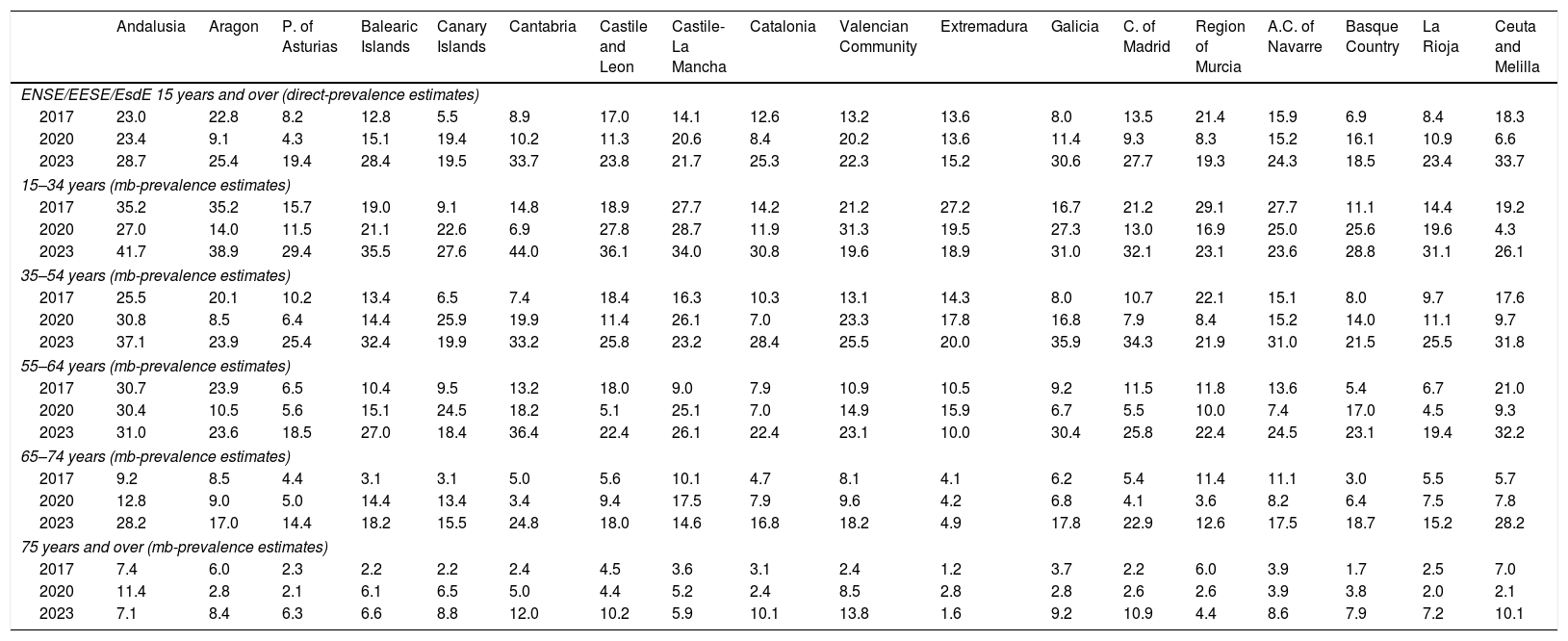
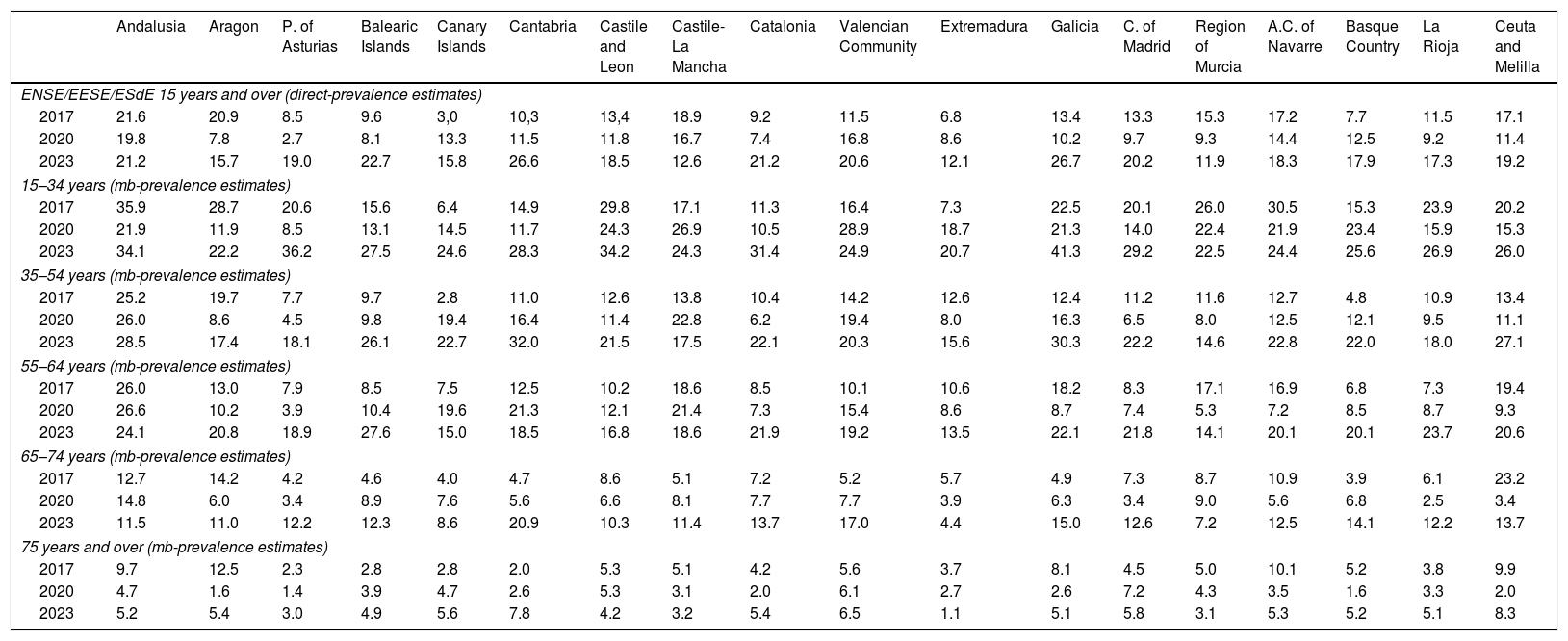
In 2023, mb-prevalence estimates suggest that prevalence of exposure to SHS by sex and age group varies across ACs. The highest exposure was generally associated with the youngest age group across all ACs and both sexes. The maximum exposure among men was observed in Cantabria [44.0% (95% CI: 30.3–57.7), ages 15–34], and the minimum in Extremadura [1.6% (95% CI: 0.3–2.9), ≥75 years]. Among women, the corresponding values were found in Galicia [41.3% (95% CI: 29.0–53.7), ages 15–34] and Extremadura [1.1% (95% CI: 0.3–2.0), ≥75 years].
Variability in mb-prevalence estimates by age group was observed in both sexes. In Extremadura, the prevalence ratio comparing the 15–34 age group with the ≥75 age group was 11.8 in men and 18.8 in women, whereas in the Valencian Community these ratios were 1.4 and 3.8, respectively. Between 2017, 2020, and 2023, mb-prevalence estimates suggested an increasing trend in SHS exposure across most ACs, in both men and women of all age groups. An exception was the stabilization of exposure prevalence in both sexes in Andalusia and Extremadura (Tables 1 and 2).
Prevalence of secondhand tobacco smoke exposure in the autonomous communities and autonomous cities of Spain among men, by age groups, obtained using a small-area model for the years 2017, 2020, and 2023.
| Andalusia | Aragon | P. of Asturias | Balearic Islands | Canary Islands | Cantabria | Castile and Leon | Castile-La Mancha | Catalonia | Valencian Community | Extremadura | Galicia | C. of Madrid | Region of Murcia | A.C. of Navarre | Basque Country | La Rioja | Ceuta and Melilla | |
|---|---|---|---|---|---|---|---|---|---|---|---|---|---|---|---|---|---|---|
| ENSE/EESE/EsdE 15 years and over (direct-prevalence estimates) | ||||||||||||||||||
| 2017 | 23.0 | 22.8 | 8.2 | 12.8 | 5.5 | 8.9 | 17.0 | 14.1 | 12.6 | 13.2 | 13.6 | 8.0 | 13.5 | 21.4 | 15.9 | 6.9 | 8.4 | 18.3 |
| 2020 | 23.4 | 9.1 | 4.3 | 15.1 | 19.4 | 10.2 | 11.3 | 20.6 | 8.4 | 20.2 | 13.6 | 11.4 | 9.3 | 8.3 | 15.2 | 16.1 | 10.9 | 6.6 |
| 2023 | 28.7 | 25.4 | 19.4 | 28.4 | 19.5 | 33.7 | 23.8 | 21.7 | 25.3 | 22.3 | 15.2 | 30.6 | 27.7 | 19.3 | 24.3 | 18.5 | 23.4 | 33.7 |
| 15–34 years (mb-prevalence estimates) | ||||||||||||||||||
| 2017 | 35.2 | 35.2 | 15.7 | 19.0 | 9.1 | 14.8 | 18.9 | 27.7 | 14.2 | 21.2 | 27.2 | 16.7 | 21.2 | 29.1 | 27.7 | 11.1 | 14.4 | 19.2 |
| 2020 | 27.0 | 14.0 | 11.5 | 21.1 | 22.6 | 6.9 | 27.8 | 28.7 | 11.9 | 31.3 | 19.5 | 27.3 | 13.0 | 16.9 | 25.0 | 25.6 | 19.6 | 4.3 |
| 2023 | 41.7 | 38.9 | 29.4 | 35.5 | 27.6 | 44.0 | 36.1 | 34.0 | 30.8 | 19.6 | 18.9 | 31.0 | 32.1 | 23.1 | 23.6 | 28.8 | 31.1 | 26.1 |
| 35–54 years (mb-prevalence estimates) | ||||||||||||||||||
| 2017 | 25.5 | 20.1 | 10.2 | 13.4 | 6.5 | 7.4 | 18.4 | 16.3 | 10.3 | 13.1 | 14.3 | 8.0 | 10.7 | 22.1 | 15.1 | 8.0 | 9.7 | 17.6 |
| 2020 | 30.8 | 8.5 | 6.4 | 14.4 | 25.9 | 19.9 | 11.4 | 26.1 | 7.0 | 23.3 | 17.8 | 16.8 | 7.9 | 8.4 | 15.2 | 14.0 | 11.1 | 9.7 |
| 2023 | 37.1 | 23.9 | 25.4 | 32.4 | 19.9 | 33.2 | 25.8 | 23.2 | 28.4 | 25.5 | 20.0 | 35.9 | 34.3 | 21.9 | 31.0 | 21.5 | 25.5 | 31.8 |
| 55–64 years (mb-prevalence estimates) | ||||||||||||||||||
| 2017 | 30.7 | 23.9 | 6.5 | 10.4 | 9.5 | 13.2 | 18.0 | 9.0 | 7.9 | 10.9 | 10.5 | 9.2 | 11.5 | 11.8 | 13.6 | 5.4 | 6.7 | 21.0 |
| 2020 | 30.4 | 10.5 | 5.6 | 15.1 | 24.5 | 18.2 | 5.1 | 25.1 | 7.0 | 14.9 | 15.9 | 6.7 | 5.5 | 10.0 | 7.4 | 17.0 | 4.5 | 9.3 |
| 2023 | 31.0 | 23.6 | 18.5 | 27.0 | 18.4 | 36.4 | 22.4 | 26.1 | 22.4 | 23.1 | 10.0 | 30.4 | 25.8 | 22.4 | 24.5 | 23.1 | 19.4 | 32.2 |
| 65–74 years (mb-prevalence estimates) | ||||||||||||||||||
| 2017 | 9.2 | 8.5 | 4.4 | 3.1 | 3.1 | 5.0 | 5.6 | 10.1 | 4.7 | 8.1 | 4.1 | 6.2 | 5.4 | 11.4 | 11.1 | 3.0 | 5.5 | 5.7 |
| 2020 | 12.8 | 9.0 | 5.0 | 14.4 | 13.4 | 3.4 | 9.4 | 17.5 | 7.9 | 9.6 | 4.2 | 6.8 | 4.1 | 3.6 | 8.2 | 6.4 | 7.5 | 7.8 |
| 2023 | 28.2 | 17.0 | 14.4 | 18.2 | 15.5 | 24.8 | 18.0 | 14.6 | 16.8 | 18.2 | 4.9 | 17.8 | 22.9 | 12.6 | 17.5 | 18.7 | 15.2 | 28.2 |
| 75 years and over (mb-prevalence estimates) | ||||||||||||||||||
| 2017 | 7.4 | 6.0 | 2.3 | 2.2 | 2.2 | 2.4 | 4.5 | 3.6 | 3.1 | 2.4 | 1.2 | 3.7 | 2.2 | 6.0 | 3.9 | 1.7 | 2.5 | 7.0 |
| 2020 | 11.4 | 2.8 | 2.1 | 6.1 | 6.5 | 5.0 | 4.4 | 5.2 | 2.4 | 8.5 | 2.8 | 2.8 | 2.6 | 2.6 | 3.9 | 3.8 | 2.0 | 2.1 |
| 2023 | 7.1 | 8.4 | 6.3 | 6.6 | 8.8 | 12.0 | 10.2 | 5.9 | 10.1 | 13.8 | 1.6 | 9.2 | 10.9 | 4.4 | 8.6 | 7.9 | 7.2 | 10.1 |
ENSE: National Health Survey of Spain / Encuesta Nacional de Salud de España; EESE: European Health Survey for Spain / Encuesta Europea de Salud en España; EsdE: National Health Survey of Spain / Encuesta de Salud de España; mb-prevalence: model-based prevalence.
Prevalence of secondhand tobacco smoke exposure in the autonomous communities and autonomous cities of Spain among women, by age groups, obtained using a small-area model for the years 2017, 2020, and 2023.
| Andalusia | Aragon | P. of Asturias | Balearic Islands | Canary Islands | Cantabria | Castile and Leon | Castile-La Mancha | Catalonia | Valencian Community | Extremadura | Galicia | C. of Madrid | Region of Murcia | A.C. of Navarre | Basque Country | La Rioja | Ceuta and Melilla | |
|---|---|---|---|---|---|---|---|---|---|---|---|---|---|---|---|---|---|---|
| ENSE/EESE/ESdE 15 years and over (direct-prevalence estimates) | ||||||||||||||||||
| 2017 | 21.6 | 20.9 | 8.5 | 9.6 | 3,0 | 10,3 | 13,4 | 18.9 | 9.2 | 11.5 | 6.8 | 13.4 | 13.3 | 15.3 | 17.2 | 7.7 | 11.5 | 17.1 |
| 2020 | 19.8 | 7.8 | 2.7 | 8.1 | 13.3 | 11.5 | 11.8 | 16.7 | 7.4 | 16.8 | 8.6 | 10.2 | 9.7 | 9.3 | 14.4 | 12.5 | 9.2 | 11.4 |
| 2023 | 21.2 | 15.7 | 19.0 | 22.7 | 15.8 | 26.6 | 18.5 | 12.6 | 21.2 | 20.6 | 12.1 | 26.7 | 20.2 | 11.9 | 18.3 | 17.9 | 17.3 | 19.2 |
| 15–34 years (mb-prevalence estimates) | ||||||||||||||||||
| 2017 | 35.9 | 28.7 | 20.6 | 15.6 | 6.4 | 14.9 | 29.8 | 17.1 | 11.3 | 16.4 | 7.3 | 22.5 | 20.1 | 26.0 | 30.5 | 15.3 | 23.9 | 20.2 |
| 2020 | 21.9 | 11.9 | 8.5 | 13.1 | 14.5 | 11.7 | 24.3 | 26.9 | 10.5 | 28.9 | 18.7 | 21.3 | 14.0 | 22.4 | 21.9 | 23.4 | 15.9 | 15.3 |
| 2023 | 34.1 | 22.2 | 36.2 | 27.5 | 24.6 | 28.3 | 34.2 | 24.3 | 31.4 | 24.9 | 20.7 | 41.3 | 29.2 | 22.5 | 24.4 | 25.6 | 26.9 | 26.0 |
| 35–54 years (mb-prevalence estimates) | ||||||||||||||||||
| 2017 | 25.2 | 19.7 | 7.7 | 9.7 | 2.8 | 11.0 | 12.6 | 13.8 | 10.4 | 14.2 | 12.6 | 12.4 | 11.2 | 11.6 | 12.7 | 4.8 | 10.9 | 13.4 |
| 2020 | 26.0 | 8.6 | 4.5 | 9.8 | 19.4 | 16.4 | 11.4 | 22.8 | 6.2 | 19.4 | 8.0 | 16.3 | 6.5 | 8.0 | 12.5 | 12.1 | 9.5 | 11.1 |
| 2023 | 28.5 | 17.4 | 18.1 | 26.1 | 22.7 | 32.0 | 21.5 | 17.5 | 22.1 | 20.3 | 15.6 | 30.3 | 22.2 | 14.6 | 22.8 | 22.0 | 18.0 | 27.1 |
| 55–64 years (mb-prevalence estimates) | ||||||||||||||||||
| 2017 | 26.0 | 13.0 | 7.9 | 8.5 | 7.5 | 12.5 | 10.2 | 18.6 | 8.5 | 10.1 | 10.6 | 18.2 | 8.3 | 17.1 | 16.9 | 6.8 | 7.3 | 19.4 |
| 2020 | 26.6 | 10.2 | 3.9 | 10.4 | 19.6 | 21.3 | 12.1 | 21.4 | 7.3 | 15.4 | 8.6 | 8.7 | 7.4 | 5.3 | 7.2 | 8.5 | 8.7 | 9.3 |
| 2023 | 24.1 | 20.8 | 18.9 | 27.6 | 15.0 | 18.5 | 16.8 | 18.6 | 21.9 | 19.2 | 13.5 | 22.1 | 21.8 | 14.1 | 20.1 | 20.1 | 23.7 | 20.6 |
| 65–74 years (mb-prevalence estimates) | ||||||||||||||||||
| 2017 | 12.7 | 14.2 | 4.2 | 4.6 | 4.0 | 4.7 | 8.6 | 5.1 | 7.2 | 5.2 | 5.7 | 4.9 | 7.3 | 8.7 | 10.9 | 3.9 | 6.1 | 23.2 |
| 2020 | 14.8 | 6.0 | 3.4 | 8.9 | 7.6 | 5.6 | 6.6 | 8.1 | 7.7 | 7.7 | 3.9 | 6.3 | 3.4 | 9.0 | 5.6 | 6.8 | 2.5 | 3.4 |
| 2023 | 11.5 | 11.0 | 12.2 | 12.3 | 8.6 | 20.9 | 10.3 | 11.4 | 13.7 | 17.0 | 4.4 | 15.0 | 12.6 | 7.2 | 12.5 | 14.1 | 12.2 | 13.7 |
| 75 years and over (mb-prevalence estimates) | ||||||||||||||||||
| 2017 | 9.7 | 12.5 | 2.3 | 2.8 | 2.8 | 2.0 | 5.3 | 5.1 | 4.2 | 5.6 | 3.7 | 8.1 | 4.5 | 5.0 | 10.1 | 5.2 | 3.8 | 9.9 |
| 2020 | 4.7 | 1.6 | 1.4 | 3.9 | 4.7 | 2.6 | 5.3 | 3.1 | 2.0 | 6.1 | 2.7 | 2.6 | 7.2 | 4.3 | 3.5 | 1.6 | 3.3 | 2.0 |
| 2023 | 5.2 | 5.4 | 3.0 | 4.9 | 5.6 | 7.8 | 4.2 | 3.2 | 5.4 | 6.5 | 1.1 | 5.1 | 5.8 | 3.1 | 5.3 | 5.2 | 5.1 | 8.3 |
ENSE: National Health Survey of Spain / Encuesta Nacional de Salud de España; EESE: European Health Survey for Spain / Encuesta Europea de Salud en España; EsdE: National Health Survey of Spain / Encuesta de Salud de España; mb-prevalence: model-based prevalence.
Mb-prevalence estimates improved the precision of direct-prevalence estimates. In 2023, the median of the CV for mb-prevalence estimates was 15.8% compared to 23.9% for direct-prevalence estimates. Only two CV associated with mb-prevalence estimates exceeded the acceptable threshold of 30%. These estimates correspond to men (CV=42.8%) and women (CV=38.5%) aged ≥75 in Extremadura.
Absolute differences between direct- and mb-prevalence estimates across the 180 areas showed, for 2023, a median of 2.1 percentage points (interquartile range: 0.9–3.8).
The differences in SHS exposure identified across ACs by sex and age group provide valuable information on the population subgroups to which tobacco control policies should be targeted. These subgroups include, for instance, young men in Cantabria and Andalusia and young women in Galicia, where exposure prevalences exceed 40%. Across all ACs, the highest prevalence of SHS exposure was consistently observed in the youngest age group.
A general decline in SHS exposure with age was observed, albeit with varying intensity. In the Basque Country, mb-prevalence estimates did not decrease as markedly with age, particularly among men. Extremadura showed the lowest exposure in 2023, particularly among men and women aged ≥65. In addition, prevalence stabilized in Extremadura except in the 15–34 age group, where it decreased in men and increased in women. In 2023, smoking prevalence in Extremadura was estimated at 23%, placing it among the ACs with the highest proportion of smokers. One possible explanation for the finding in Extremadura is that smoking prevalence does not necessarily reflect SHS exposure. Regional characteristics such as a higher proportion of single-family homes with outdoor spaces, together with a climate that favors outdoor smoking, could displace tobacco use away from enclosed settings thereby reducing SHS exposure among non-smokers. This explanation is nonetheless difficult to reconcile with other patterns observed. For instance, Andalusia, with comparable climatic conditions and one of the highest smoking prevalence in Spain, has also one of the highest prevalence of SHS exposure [4]. Housing and climate alone therefore appear insufficient to account for the regional differences observed, which are more likely to reflect differences in household smoking rules or the social acceptability of smoking indoors.
Although a general decline in mb-prevalence estimates was found in 2023, an increase in exposure in indoor settings was observed. This increase may reflect changes in exposure patterns, possibly related to relaxed compliance with tobacco control measures in workplaces and leisure venues. It should be noted that more than two decades have elapsed since the adoption of Spain's first tobacco control law (Law 28/2005), and its impact may have waned. As a result, despite continued public support for legislation protecting health, there has been insufficient progress in the expansion of smoke-free spaces [7,8]. It is also possible that the COVID-19 pandemic and the associated lockdown influenced the trends observed. The increase in exposure prevalence observed in 2023 may reflect the return to pre-pandemic social behaviors. However, this increase in exposure prevalence should be interpreted with caution, as differences in survey context or reporting behavior across survey waves may have affected comparability.
This study has limitations. The information provided by the Spanish health surveys on SHS exposure is constrained by the question used. This question covers only indoor exposure, without differentiating specific settings. In addition, a dichotomous exposure categorization was considered, without taking into account frequency or duration of exposure. Although lung cancer hospital admissions were included as an auxiliary variable because lung cancer is a health outcome causally associated with SHS exposure [9], their inclusion may have influenced the mb-prevalence estimates due to the long latency of lung cancer and the predominant contribution of smoking to its incidence. In addition, other outcomes, such as ischemic heart disease, may provide complementary information and could be explored as alternative auxiliary variables in future applications of the model. The predictive performance of the selected model was not formally validated internally or externally. Moreover, the broad age categories considered may have masked differences in SHS exposure within each age group. The main strength of this study is the proposed methodology, that yields precise prevalence estimates of exposure to SHS in the ACs by sex and age group.
The availability of sex- and age-specific prevalences for different health risk factors at the regional level is useful for the design of effective health policies and interventions. The findings of this study suggest the existence of differences in population-level SHS exposure between ACs by sex and age group. Making relevant epidemiological data available to the scientific community and health decision-makers is essential to inform evidence-based policy. In the case of SHS exposure, clinical applicability is also clear, given the established causal relationship between exposure to this risk factor and morbidity-mortality from lung cancer, respiratory diseases, and cardiovascular diseases [1].
Declaration of generative AI and AI-assisted technologies in the writing processNone declared.
FundingThis work was funded by the Instituto de Salud Carlos III (ISCIII) via project PI25/00937 and cofunded by the European Union. It also received funding through a SEPAR 2023 grant (Project 1426).
Conflicts of interestThe authors declare not to have any conflicts of interest that may be considered to influence directly or indirectly the content of the manuscript.