
Pulmonary alveolar proteinosis (PAP) is a rare disorder characterized by intra-alveolar surfactant accumulation due to defective macrophage clearance [1]. Although autoimmune PAP is the most common form, secondary PAP (accounting for <10% of cases) is often associated with hematologic malignancies or immunodeficiencies that impair macrophage maturation. We report a case of PAP secondary to MonoMAC syndrome in a patient carrying a previously undescribed germline GATA2 mutation.
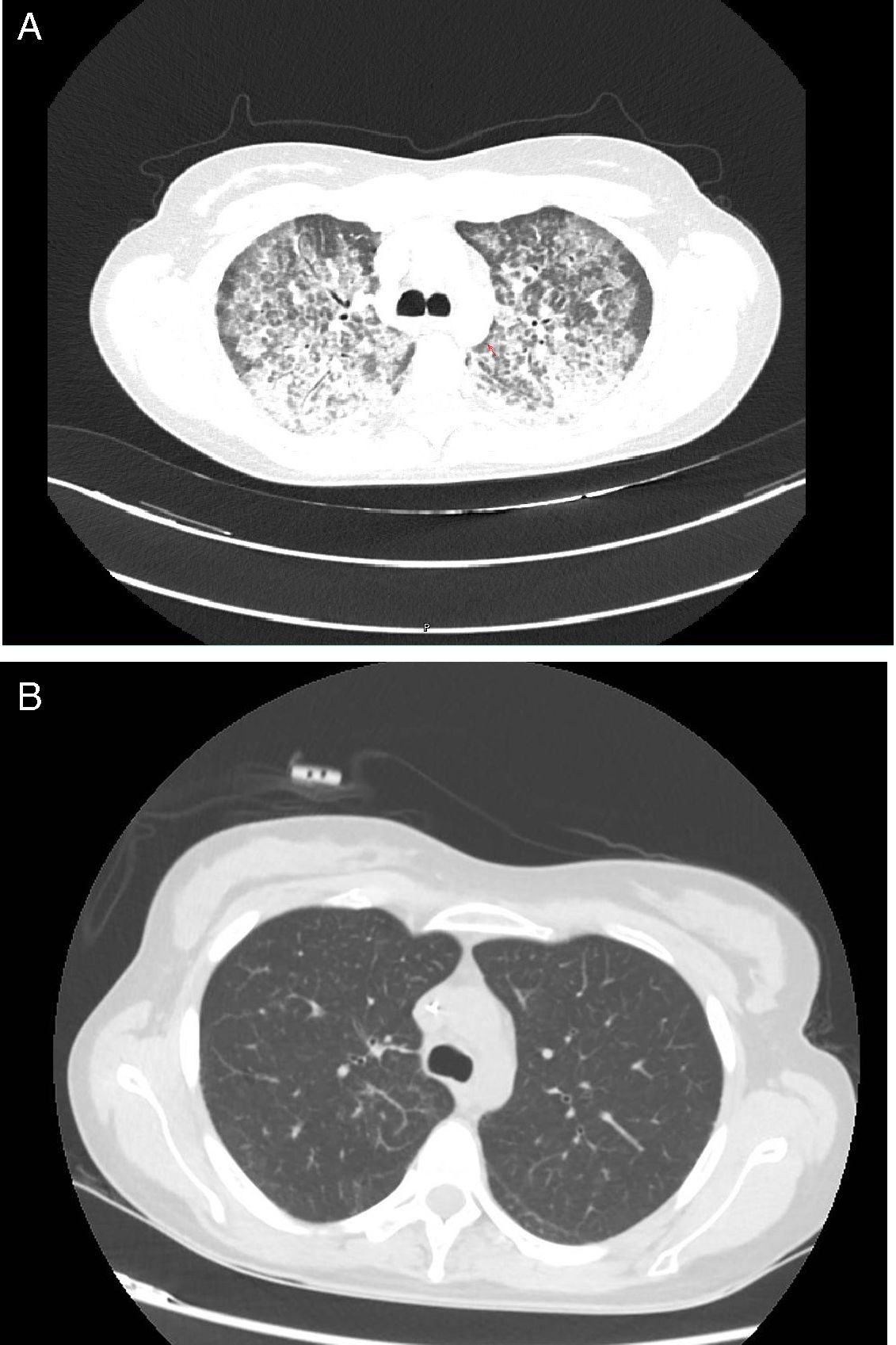
A 23-year-old woman presented with progressive exertional dyspnea and cough. Her medical history included idiopathic erythema nodosum, chronic anemia, and a prior tubo-ovarian abscess. Physical examination revealed fine inspiratory crackles and oxygen saturation of 93% on room air. Pulmonary function tests showed a mild restrictive defect (FVC, 70%; FEV1, 76%) and a markedly reduced diffusing capacity (34%). High-resolution computed tomography (HRCT) demonstrated diffuse bilateral ground-glass opacities with a crazy-paving pattern (Fig. 1A).

Bronchoalveolar lavage yielded milky fluid positive for periodic acid-Schiff (PAS) material, and transbronchial biopsy confirmed PAP. Further evaluation included a 6-minute walk test showing significant desaturation to 89%. Extensive testing for surfactant protein mutations and anti-GM-CSF antibodies was negative. However, complete blood count revealed severe monocytopenia and lymphopenia. Peripheral blood immunophenotyping confirmed complete absence of monocytes and reduced B-cell and natural killer cell counts. Genetic sequencing identified a novel heterozygous germline mutation in GATA2: c.1124T>A (p.Leu375His). Bone marrow biopsy showed hypocellularity and trilineage dysplasia, while cytogenetic analysis revealed mosaic trisomy 8. These findings established the diagnosis of low-risk myelodysplastic syndrome (MDS) associated with GATA2 deficiency. The same mutation was also identified in the patient's asymptomatic father.
The patient initially underwent 2 sessions of whole-lung lavage (WLL), which led to clinical improvement and an increase in diffusing capacity to 56%, although radiological improvement was limited. Given the underlying hematologic defect, she was referred for allogeneic hematopoietic stem cell transplantation (HSCT). She received peripheral blood stem cells from a matched unrelated donor following a myeloablative conditioning regimen with busulfan and fludarabine. The post-transplant course was complicated only by mild cutaneous graft-versus-host disease and transient hemorrhagic cystitis. Remarkably, 2 months after HSCT, chest CT showed complete resolution of the parenchymal abnormalities (Fig. 1B).
Secondary PAP remains a therapeutic challenge. Although WLL is the standard treatment for symptomatic relief, it does not correct the underlying macrophage lineage defect in genetic or hematologic disorders [2]. In GATA2 deficiency, HSCT is usually indicated for bone marrow failure or MDS [3]. This case illustrates that HSCT may also be curative for severe pulmonary involvement, provided it is performed before irreversible fibrosis develops [4,5]. Our findings highlight the importance of recognizing PAP as a possible manifestation of MonoMAC syndrome and describe a novel likely pathogenic GATA2 variant.
CRediT authorship contribution statementAll authors participated in the patient's care and clinical decision-making or performed essential diagnostic procedures. All authors also contributed to the preparation, synthesis, writing, and revision of the final manuscript.
Ethics and informed consentWritten informed consent for participation and publication of clinical details and images was obtained from the patient. All identifying information has been omitted to preserve anonymity.
Declaration of generative AI and AI-assisted technologies in the writing processArtificial intelligence was used for translation and language refinement of the text.
FundingThis research received no specific grant from funding agencies in the public, commercial, or not-for-profit sectors.
Conflicts of interestThe authors declare no conflicts of interest that could be considered to have directly or indirectly influenced the content of this manuscript.
The authors thank Dr. José Luis Izquierdo Alonso for his assistance in the preparation and revision of the manuscript.