

A 66-year-old female patient with obesity, arterial hypertension, type 2 diabetes mellitus, and Forestier–Rotés syndrome or diffuse idiopathic skeletal hyperostosis (DISH), diagnosed with severe obstructive sleep apnea (OSA) was referred to our clinic due to persistent excessive daytime sleepiness despite continuous positive airway pressure (CPAP) use. Sequential optimization with auto-CPAP and non-invasive ventilation (NIV) failed to achieve clinical improvement, with residual apnea-hypopnea index remaining at 55events/h, all of obstructive type. Upper airway endoscopy revealed marked posterior pharyngeal wall protrusion causing severe stenosis, unresponsive to CPAP or NIV under direct visualization (Fig. 1 A and B). Cervical computed tomography (Fig. 1C) confirmed voluminous ossifications of the atlanto-odontoid joint exerting mass effect on the posterior oropharyngeal wall, related to the patient's rheumatological condition. The case was discussed with the Neurosurgery department, which recommended surgical treatment. Given cervical compression precluding orotracheal intubation, tracheotomy was required prior to surgery. OSA refractory to positive pressure therapy, despite adequate titration, should raise suspicion of underlying anatomical causes [1–3]. In these scenarios, positive pressure therapy may prove ineffective even at high pressures. This case underscores the role of respiratory endoscopy and imaging techniques in patients with poor clinical progression, to identify uncommon etiologies and consider specific therapeutic alternatives [4].
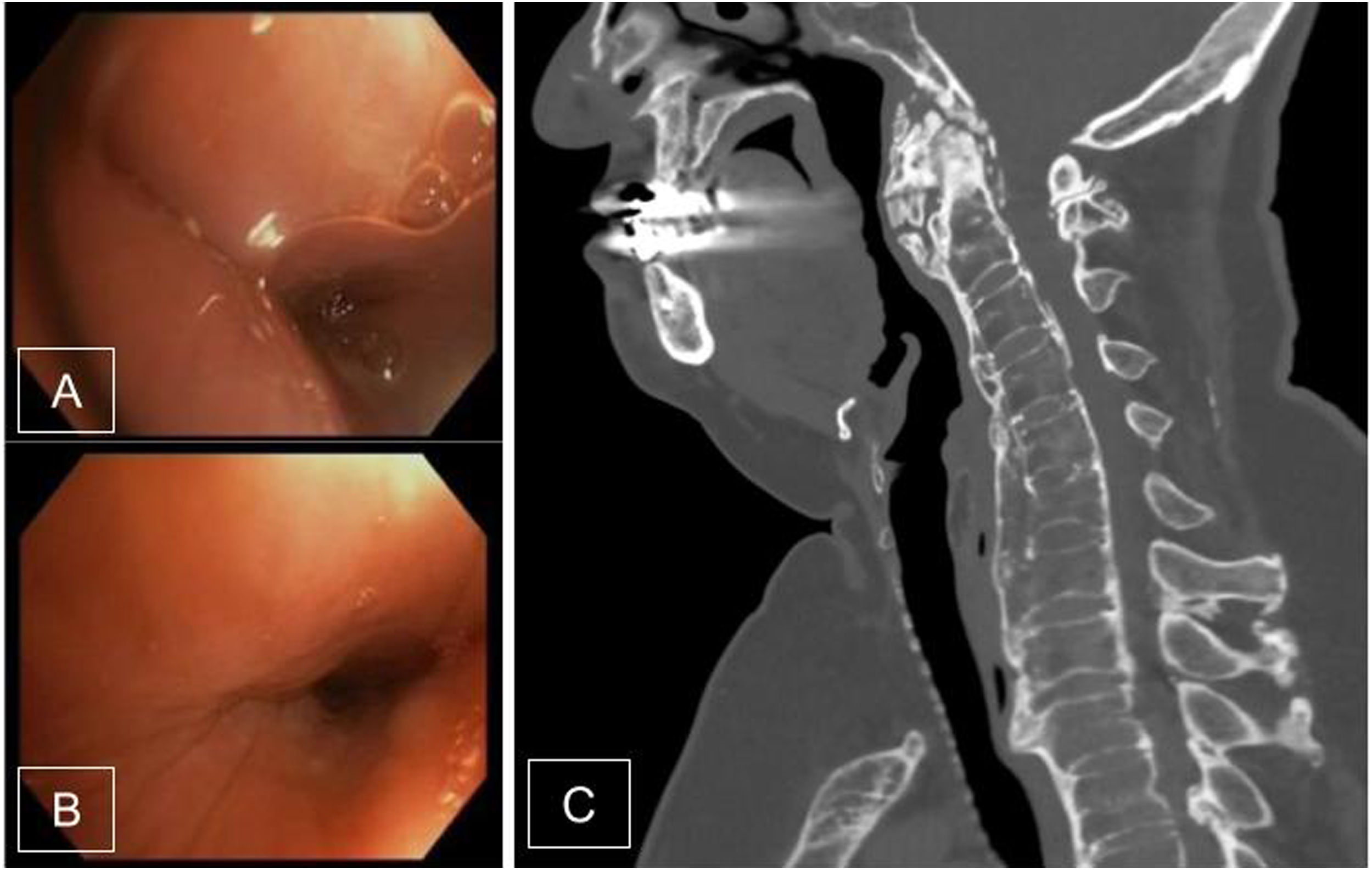
(A) Under endoscopic visualization, CPAP application showed no improvement in airway caliber. (B) NIV application achieved only modest airway patency at very high pressures (IPAP 25, EPAP 16 cmH2O). (C) Cervical computed tomography showing voluminous ossifications of the atlanto-odontoid joint exerting a mass effect on the posterior oropharyngeal wall.
The authors declare that no artificial intelligence tools were used in the preparation of this manuscript.
FundingThis research did not receive any specific grant from funding agencies in the public, commercial, or not-for-profit sectors.
Conflicts of interestThe authors declare that they have no conflicts of interest related to this manuscript.