Enhanced recovery after surgery (ERAS) pathways have consistently improved postoperative recovery across multiple surgical specialties, and thoracic surgery is no exception [1]. In minimally invasive anatomical pulmonary resection, the benefits of ERAS are increasingly associated with shorter hospital stays and reduced resource use, although economic evidence from public hospital settings remains limited [2,3].
We evaluated the effect of an ERAS protocol in patients undergoing uniportal video-assisted thoracoscopic surgery with robotic-arm assistance for anatomical pulmonary resection at a Spanish public hospital. We compared 50 patients who received standard postoperative care with 50 consecutive patients treated after implementation of the ERAS protocol. The protocol followed the recommendations of the ERAS Society and the European Society of Thoracic Surgeons and included preoperative education, respiratory optimization, shortened preoperative fasting, multimodal analgesia, early mobilization, intensive respiratory physiotherapy, and standardized early chest tube removal [1,4].
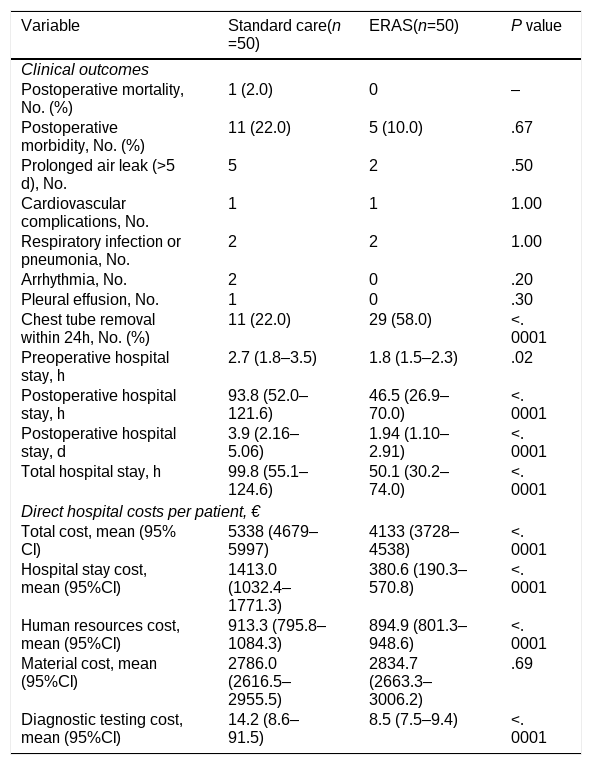
From a clinical perspective, the ERAS group had a significantly shorter postoperative hospital stay (1.94 vs 3.90 days; P<.0001) and total hospital stay (50.1 vs 99.8h; P<.0001) (Table 1). Chest tube removal within 24h was more than twice as frequent in the ERAS group (58% vs 22%; P<.0001). Postoperative morbidity was also lower in the ERAS group (10% vs 22%), whereas no significant difference in mortality was observed (0% vs 2%).
Impact of enhanced recovery after surgery on postoperative recovery and direct hospital costs after anatomical pulmonary resection.
| Variable | Standard care(n=50) | ERAS(n=50) | P value |
|---|---|---|---|
| Clinical outcomes | |||
| Postoperative mortality, No. (%) | 1 (2.0) | 0 | – |
| Postoperative morbidity, No. (%) | 11 (22.0) | 5 (10.0) | .67 |
| Prolonged air leak (>5d), No. | 5 | 2 | .50 |
| Cardiovascular complications, No. | 1 | 1 | 1.00 |
| Respiratory infection or pneumonia, No. | 2 | 2 | 1.00 |
| Arrhythmia, No. | 2 | 0 | .20 |
| Pleural effusion, No. | 1 | 0 | .30 |
| Chest tube removal within 24h, No. (%) | 11 (22.0) | 29 (58.0) | <.0001 |
| Preoperative hospital stay, h | 2.7 (1.8–3.5) | 1.8 (1.5–2.3) | .02 |
| Postoperative hospital stay, h | 93.8 (52.0–121.6) | 46.5 (26.9–70.0) | <.0001 |
| Postoperative hospital stay, d | 3.9 (2.16–5.06) | 1.94 (1.10–2.91) | <.0001 |
| Total hospital stay, h | 99.8 (55.1–124.6) | 50.1 (30.2–74.0) | <.0001 |
| Direct hospital costs per patient, € | |||
| Total cost, mean (95%CI) | 5338 (4679–5997) | 4133 (3728–4538) | <.0001 |
| Hospital stay cost, mean (95%CI) | 1413.0 (1032.4–1771.3) | 380.6 (190.3–570.8) | <.0001 |
| Human resources cost, mean (95%CI) | 913.3 (795.8–1084.3) | 894.9 (801.3–948.6) | <.0001 |
| Material cost, mean (95%CI) | 2786.0 (2616.5–2955.5) | 2834.7 (2663.3–3006.2) | .69 |
| Diagnostic testing cost, mean (95%CI) | 14.2 (8.6–91.5) | 8.5 (7.5–9.4) | <.0001 |
Data are expressed as number (percentage) or mean (95%CI or range), as appropriate. Cost data are presented as mean (95%CI) in euros. Between-group comparisons were performed using the Mann–Whitney U test. A 2-sided P value<.05 was considered statistically significant.
ERAS, enhanced recovery after surgery; 95%CI, 95% confidence interval.
The principal economic finding was a significant reduction in the mean direct hospital cost per patient in the ERAS group (€4133 vs €5338; P<.0001), representing an estimated saving of €1205 per case based on the more conservative comparison presented in Table 1. The largest contribution to these savings resulted from lower costs associated with hospital stay (€381 vs €1413; P<.0001). Human resource and diagnostic testing costs were also significantly lower in the ERAS group (P<.0001 for both). By contrast, material costs remained unchanged (€2834.70 vs €2786.00; P=.69), indicating that the savings were attributable to more efficient perioperative management rather than reduced use of surgical technology.
Our findings support the implementation of ERAS pathways in anatomical pulmonary resection as a cost-effective organizational strategy in thoracic surgery [2,3,5]. In public healthcare systems with constrained budgets, the economic benefit appears to derive primarily from shorter postoperative hospital stays while maintaining the clinical safety expected with minimally invasive surgery [4]. These findings are consistent with previous cost-effectiveness analyses showing that ERAS programs reduce complications and length of hospitalization, 2 major contributors to the financial burden associated with pulmonary resection [5].
Authors’ contributionsJMCP, AAS, ATS and JLDT conceptualized the study and collected the data. JSM, LSG, JMCP and AAS contributed to the analysis of the cases and treatment of the patients. JMCP drafted the manuscript, and all authors reviewed and edited the paper and approved the final version.
Ethics statementThis observational study was conducted in accordance with the ethical principles of the Declaration of Helsinki and was approved by the institutional review board of Hospital Universitario del Vinalopó on April 26, 2023 (reference FAST-TRACK).
Artificial intelligence statementNo part of this material was produced, either in whole or in part, with the assistance of artificial intelligence software or tools.
FundingNone declared.
Conflicts of interestNone declared.