

We thank Dr. Li and Dr. Liu for their thoughtful comments regarding our study on the potential clinical implications of ECG-based risk stratification in a large cohort of hemodynamically stable patients with acute pulmonary embolism (PE) [1]. In our study, we hypothesized that a predefined normal ECG, when incorporated into the simplified Pulmonary Embolism Severity Index (sPESI), could refine risk classification and identify a subgroup of patients at very low risk of short-term adverse outcomes. Importantly, the sPESI-ECG strategy was evaluated as a risk-classification strategy rather than as an intervention or a discharge pathway. Because RIETE is an observational registry and patient management was not assigned according to sPESI-ECG, our findings cannot establish whether ECG-guided disposition is safe or improves clinical outcomes [2].
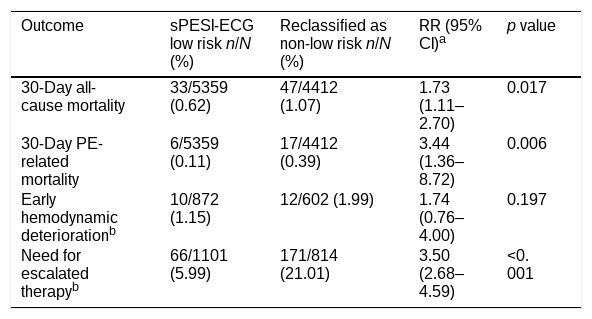
The authors raise an important question regarding the patients specifically reclassified by the ECG-based strategy. Among the 9771 patients classified as low-risk by the original sPESI, 5359 remained low-risk according to the sPESI-ECG, whereas 4412 were reclassified as non-low risk. This reclassified subgroup had significantly higher rates of 30-day all-cause mortality (1.07% vs 0.62%; RR, 1.73; 95% CI, 1.11–2.70), PE-related mortality (0.39% vs 0.11%; RR, 3.44; 95% CI, 1.36–8.72), and need for escalated therapy (21.01% vs 5.99%; RR, 3.50; 95% CI, 2.68–4.59). The rate of early hemodynamic deterioration was also numerically higher (1.99% vs 1.15%), although this difference did not reach statistical significance (RR, 1.74; 95% CI, 0.76–4.00). These component-specific results are summarized in Table 1 and suggest that ECG-based reclassification identifies clinically meaningful heterogeneity within the population considered low risk by the original sPESI.
Outcomes among patients classified as low risk by the original sPESI, according to reclassification by sPESI-ECG.
| Outcome | sPESI-ECG low risk n/N (%) | Reclassified as non-low risk n/N (%) | RR (95% CI)a | p value |
|---|---|---|---|---|
| 30-Day all-cause mortality | 33/5359 (0.62) | 47/4412 (1.07) | 1.73 (1.11–2.70) | 0.017 |
| 30-Day PE-related mortality | 6/5359 (0.11) | 17/4412 (0.39) | 3.44 (1.36–8.72) | 0.006 |
| Early hemodynamic deteriorationb | 10/872 (1.15) | 12/602 (1.99) | 1.74 (0.76–4.00) | 0.197 |
| Need for escalated therapyb | 66/1101 (5.99) | 171/814 (21.01) | 3.50 (2.68–4.59) | <0.001 |
We also agree that measures of discrimination, sensitivity, specificity, and negative predictive value should not be interpreted in isolation as evidence of clinical utility [3]. However, sPESI-ECG was conceived as a binary classification rule rather than a model yielding individual predicted probabilities; therefore, conventional calibration intercept and slope are not directly applicable to the present analysis. Regarding individual ECG patterns, these were explored in the original study, and no single component reproduced the prognostic performance of the composite normal-versus-abnormal ECG definition [1].
Ultimately, the potential value of sPESI-ECG may therefore lie not only in defining a lower-risk subgroup, but also in identifying clinically relevant heterogeneity among patients otherwise considered low risk by the original sPESI. Whether this reclassification translates into safer or more efficient outpatient management requires prospective validation within a predefined clinical pathway, ideally evaluating disposition, treatment escalation, readmission, and patient-centered outcomes.
AI statementArtificial intelligence tools were used solely for language editing and proofreading purposes. No AI tools were used for data analysis, interpretation of results, or generation of scientific content.
FundingNone.
Conflict of interestCMO has received speaker's honoraria from the pharmaceutical companies ROVI and Leo Pharma. PDR has received speaker's honoraria from the following pharmaceutical companies: ROVI, Bayer, Techdow, Menarini, Leo Pharma, Pfizer, Bristol-Myers, Sanofi, and Daichii-Sankyo. In addition, he has engaged in advisory consultancy work for Techdow, Leo Pharma, and Pfizer. FGV has received speaker's honoraria from the following pharmaceutical companies: ROVI, Techdow, Pfizer, Bristol-Myers, and Daichii-Sankyo.