Drug-induced sarcoidosis-like reactions (DISR) are non-caseating granulomatous processes temporally and causally related to systemic therapy, classically described with immune checkpoint inhibitors, anti-TNF-α agents and tyrosine kinase inhibitors, and increasingly reported with monoclonal antibodies and antibody-drug conjugates (ADCs).[1] Trastuzumab deruxtecan (T-DXd) is a HER2-directed ADC that links trastuzumab to a topoisomerase I inhibitor. Its main pulmonary toxicity is interstitial lung disease (ILD)/pneumonitis, reported in approximately 11% of patients, whereas granulomatous reactions are not addressed in current multidisciplinary guidance, which focuses on ILD/pneumonitis.[2] We report, to our knowledge, the first published case of mediastinal sarcoidosis-like reaction attributable to T-DXd in metastatic breast cancer.
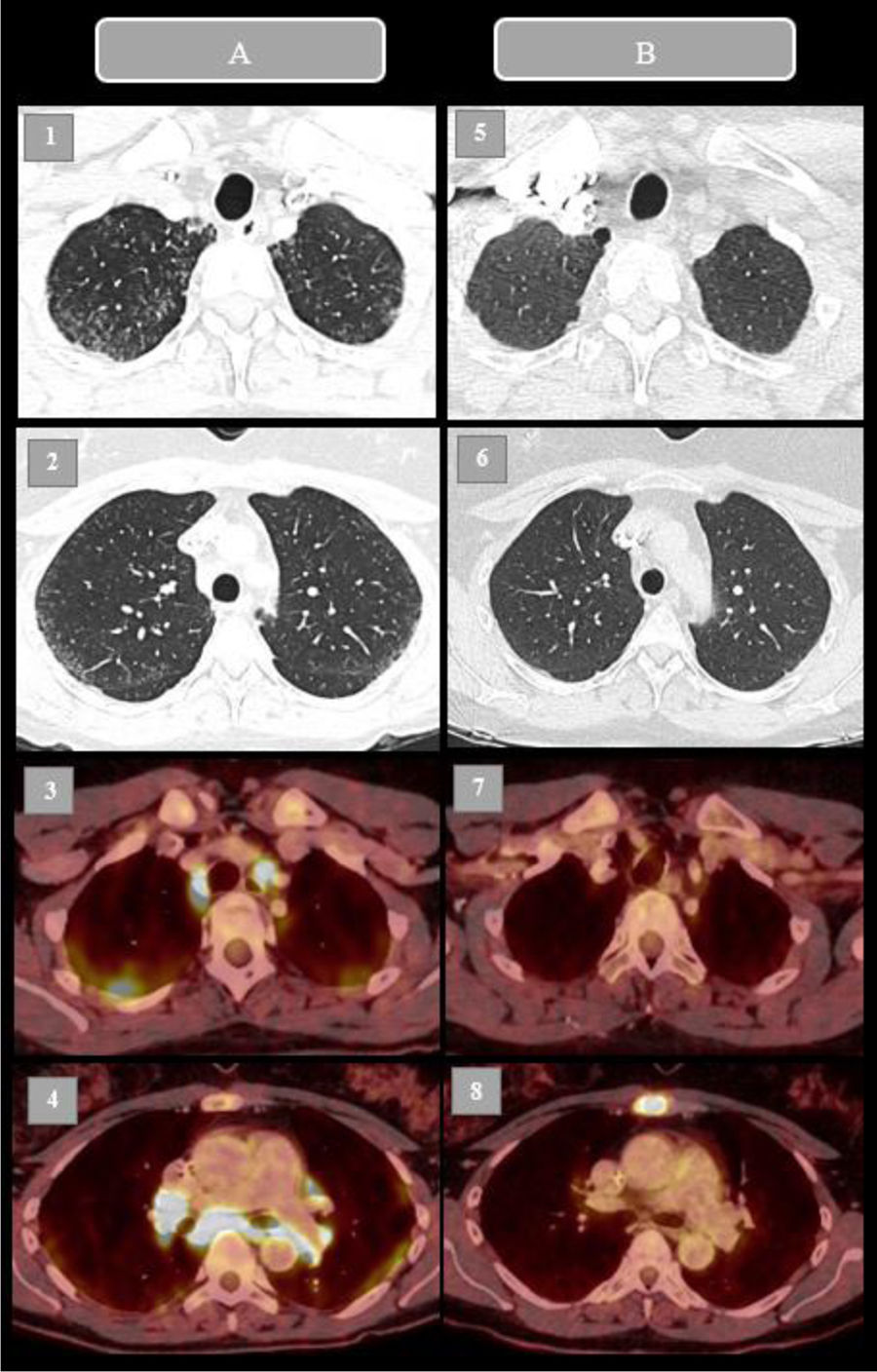
A 48-year-old woman (former smoker, less than10 pack-years) diagnosed in 2020 with ER-positive, HER2-positive metastatic breast cancer, previously treated with multiple lines of therapy including trastuzumab, pertuzumab, docetaxel, capecitabine, palbociclib, fulvestrant, and letrozole, started treatment with T-DXd in January 2025. A surveillance 18F-FDG PET-CT in March 2025 revealed new bilateral upper-lobe micronodules and FDG-avid hilar and mediastinal lymphadenopathy, initially suspicious for disease progression. EBUS cryo-biopsies of hilar and subcarinal nodes showed a non-necrotising epithelioid granulomatous reaction with abundant giant cells, consistent with sarcoid granulomas. Microbiological work-up (including mycobacteria) was negative. Ocular involvement was excluded by ophthalmological assessment and cardiac involvement by electrocardiography, echocardiography and PET-CT. Given the temporal relationship with T-DXd and the absence of alternative aetiologies, DISR was diagnosed. T-DXd was discontinued and the patient was switched to sacituzumab govitecan in May 2025. Oral prednisone (60mg/day, subsequently tapered) was administered for a total of 6 months until complete discontinuation. The patient remained respiratorily stable, with preserved pulmonary function (FEV1 2.64L [93%], FVC 3.29L [93%], DLCO 76% [haemoglobin-corrected]), and complete radiological resolution of the micronodular pattern and lymphadenopathy on follow-up PET-CT (Fig. 1). No recurrence occurred on surveillance PET-CT after the switch.

18F-FDG PET-CT before and after corticosteroid therapy for trastuzumab deruxtecan-induced sarcoidosis-like reaction. (A) Diagnostic study (left column, panels 1–4): axial CT lung-window images showing a bilateral, predominantly upper-lobe perilymphatic micronodular pattern, the morphological correlate of the FDG-avid hilar and mediastinal lymphadenopathy. (B) Control study after 6 months of corticosteroid treatment (right column, panels 5–8): fused PET-CT images demonstrating complete resolution of the pulmonary micronodules and of the mediastinal and hilar uptake. The residual focal FDG uptake in the manubrium sternum corresponds to a lytic bone metastasis from the breast carcinoma, unrelated to the sarcoidosis-like reaction.
DISR has been reported with anti-HER2 monoclonal antibodies, including trastuzumab,[3] and with pertuzumab–trastuzumab combinations, where mediastinal granulomatous reactions may mimic disease progression on PET-CT.[4] The HER2-directed antibody backbone of T-DXd plausibly shares immunological mechanisms with these monoclonals, likely involving CD4+ Th1-driven granuloma formation, while the cytotoxic payload may contribute through immunogenic cell death. The short latency in our patient (∼2 months) is consistent with the wide interval reported for DISR, from weeks to over a year. Distinguishing DISR from metastatic progression is critical, since misclassification may prompt unwarranted treatment escalation or premature discontinuation of effective oncological therapy; in published cohorts, sarcoid-like reactions have mimicked metastases in over 20% of immunotherapy-treated patients.[5] Histological confirmation by EBUS-guided cryo-biopsy is the diagnostic cornerstone, and the course is generally favourable, with resolution after drug withdrawal and corticosteroids. Although dose-reduced rechallenge may be considered, the extent of involvement led us to opt for definitive discontinuation and a switch to sacituzumab govitecan, which shares a topoisomerase I inhibitor payload but has not been associated with granulomatous reactions. With the expanding use of HER2-targeted ADCs across breast and other solid tumours, clinicians should consider sarcoidosis-like reaction in the differential diagnosis of new pulmonary nodules or lymphadenopathy arising during T-DXd therapy.
Informed consentWritten informed consent for publication was obtained from the patient, with anonymisation to preclude identification.
Artificial intelligence involvementThe authors declare that no artificial intelligence (AI) tools or AI-assisted technologies were used in the writing, drafting, editing, or preparation of this manuscript. All content, analyses, interpretations, and conclusions presented in this article were conceived and written exclusively by the authors.
FundingThis research did not receive any specific grant from funding agencies in the public, commercial, or not-for-profit sectors.
Conflicts of interestThe authors declare not to have any conflicts of interest that may be considered to influence directly or indirectly the content of the manuscript.